Torus
Spring Reverb Engine
A stereo spring reverb with a parametric engine and a physical model of the spring tank.
Free beta v0.1.0
macOS is also available as a .zip · Release notes · Changelog · SHA-256
Overview
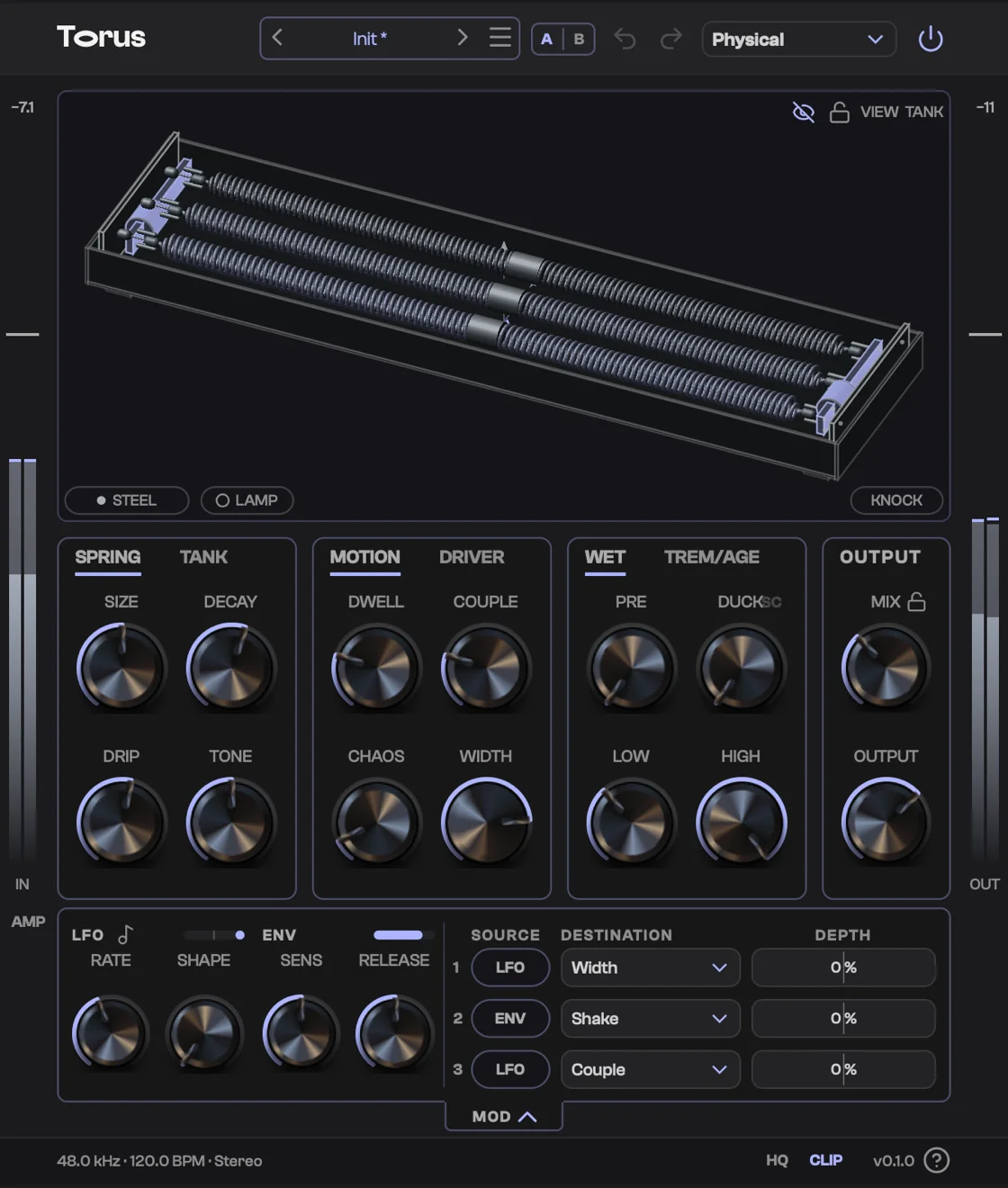
Torus is a spring reverb with two engines. Parametric is built from the spring model in Välimäki, Parker and Abel (JAES, 2010). Physical models the wire and the magnets at each end. It also models the chassis they're bolted to, and it's the engine you get when you first open it.
The physical model
Physical is a model of the an actual spring reverb tank, it is quite literally a physics engine, rather than black box model: the wire, the magnets at each end and the chassis they're bolted to are all in the signal path. The display is that same model running. Each coil is a string pinned at both ends, driven by a plate at one end and read at the other, and its tension and damping are the T and D readouts beside it.
The tank is drawn in 3D, and you can work it with the mouse. Pluck a coil, or scroll on one to stretch it. KNOCK bumps the whole tank. The plates at each end light up with the signal going in and coming back out.
The modulation drawer
Under the cards there's a drawer with one LFO and one envelope follower, routed through three slots. Each slot takes a source, a destination and a bipolar depth, and the bar under the depth shows how far that slot is pushing its destination right now. A destination the running engine can't take is greyed out in the menu, and a slot set to one says why.
Features
- Engines: Parametric or Physical, switched from the header. Physical is the default.
- Tanks: TWO, THREE, FOUR and WIDE, plus the TYPE 8 and TYPE 9 triplets. In a triplet the middle spring is shared by both sides.
- Spring display: pluck, stretch and twist the coils, knock the tank and turn the 3D view. VIEW steps through TANK, ISO, SIDE and TOP.
- Modulation: one LFO and one envelope follower, routed through three slots. Each slot takes a source, a destination and a bipolar depth. Some destinations only work on one engine.
- Driver: a tube driver with saturation (SAT), a narrower transformer (CHEAP) and a sagging supply (SAG).
- Crash and shake: hard hits can crash the springs. SHAKE rocks the tank continuously, and it's Physical only.
- Metal: click the METAL pill in the display to change the wire. Bronze runs warm and dark, stainless bright. Physical only.
- Dust and stereo: DUST wears the tank with random treble erosion and a faint hiss. STEREO keeps the input's stereo image, or sums it to mono.
- Tremolo: an opto-style throb with SPEED and DEPTH, up to a 20 dB dip.
- Output: MIX sets the dry and wet balance. CLIP safety-clips the output just below 0 dBFS, and it's on by default.
- Workflow: factory presets, undo and redo, zoom levels, and a finish and accent colour for the tank and the interface.
Formats and system requirements
- macOS: AU and VST3 plugins, plus a Standalone app. Universal, so it runs natively on Apple Silicon and Intel. macOS 11 Big Sur or later.
- Plugins run in any 64-bit host. Install steps are in the FAQ.
Changelog
Build notes go here.
Want to hear when new versions land? Join the list.
SHA-256
Verify your download
Want to check your download? Work out its SHA-256 and make sure it matches the one for that file.
The hashes for the newest build are also on its GitHub release.
shasum -a 256 ~/Downloads/Torus-*-macOS.dmgsha256sum ~/Downloads/Torus-*-Linux.zipGet-FileHash $HOME\Downloads\Torus-*-Windows.zip