 Lissajous Labs
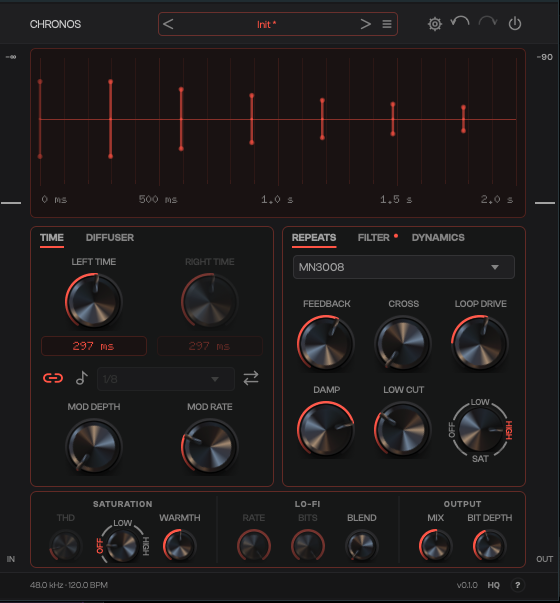
Chronos
Nonlinear Delay Engine
A stereo delay with Digital, MN3005 and MN3008 delay cores and a saturating feedback loop.
Free beta v0.1.0
macOS is also available as a .zip (16 MB) · Release notes
This beta isn't code-signed yet; notarized builds follow shortly. If your system blocks it, here's how to open it.
Overview
Chronos is a stereo delay built around a nonlinear feedback loop. Choose a clean Digital line or an emulation of the MN3005 or MN3008 bucket-brigade chip, then shape every repeat with drive, damping, diffusion and modulation, from tight slapback to long, saturated trails that run into self-oscillation.
Its saturators use first- or second-order antiderivative antialiasing (ADAA) to keep aliasing down without heavy oversampling. HQ mode adds 2× oversampling on top.
Everything needed to sit the delay in a mix is on board: an output filter, a four-band EQ, a ducker and a lo-fi crusher.
Features
- Time: 1 ms to 5 s, with linked or independent left and right times. Tempo sync from 1/64 to 4/1, including dotted and triplet values.
- Three delay cores: Digital, plus MN3005 and MN3008 bucket-brigade emulations.
- Repeats: feedback up to self-oscillation, damping, low cut, cross-feed, ping-pong and freeze.
- Saturation: THD drive, and a repeat drive inside the feedback loop, each with 1st- or 2nd-order antialiasing. Warmth adds even harmonics.
- Modulation and diffusion: delay-time modulation, plus a modulated diffuser with diffusion and size controls.
- Filter: a state-variable or Sallen-Key output filter (high- and low-pass), and a four-band parametric EQ with bell, shelf and notch bands.
- Dynamics: ducking with amount, threshold, attack and release.
- Lo-fi: sample-rate and bit crushing with blend, plus output bit depth from 32 down to 4 bits.
- Workflow: preset banks, undo and redo, and HQ 2× oversampling.
Formats and system requirements
- macOS: AU, VST3 and Standalone. macOS 11 Big Sur or later, on Apple Silicon or an Intel Mac with a Haswell-generation (2013) CPU or newer. The 2013 Mac Pro is not supported.
- Windows: Standalone app, 64-bit (x86-64).
- Linux: VST3 and Standalone, 64-bit (x86-64).
- Plugins run in any 64-bit host. Install steps are in the FAQ.
Want to hear when new versions land? Join the list.