So You Want to Model a Spring
Lucky for you, all you need is a spring, two magnets and two (or three) coils!
What's actually in the tank
Laurens Hammond patented what we know today as the electromechanical spring reverberator in 1939 (US 2,230,836), and the layout hasn't been altered much since. Very good design! A folded steel chassis, a helical spring hung across, and a transducer at each end. Each end of the wire is coupled into a small magnet, where each magnet sits in a coil. Once a signal is input, current in the drive coil flows, our coil pushes the magnet, and the magnet twists the wire. At the other end it's the same process, inverted: the magnet moves, the pickup coil detects a changing flux, and voltage gets output.
In the middle of all this sits our spring. The chassis itself rings a little too, and the magnets and coils colour the ends of the band. The smearing and chirp through, which is the whole characteristic sound of a spring reverberator, is what happens when a wave travels down metres of steel wire.
You may be asking, why a spring? Well, it's essentially a very long delay line in a very small box! 5.08 metres of wire folded up into 163 mm actually, and the wave sent across it crawls along it at about 193 m/s. That's slower than sound in air. Slow enough that one trip takes 26 ms. A tank gives you real echo spacing without a room!
Safe Travels
Wanna guess what you get when you unroll a helix? A straight rod, duh. Hold that mental model when reading the maths. \(s\) is distance along the wire, not along the tank, and the wire is \(L = 5.075\) m long. Everything below is written in terms of \(s\).
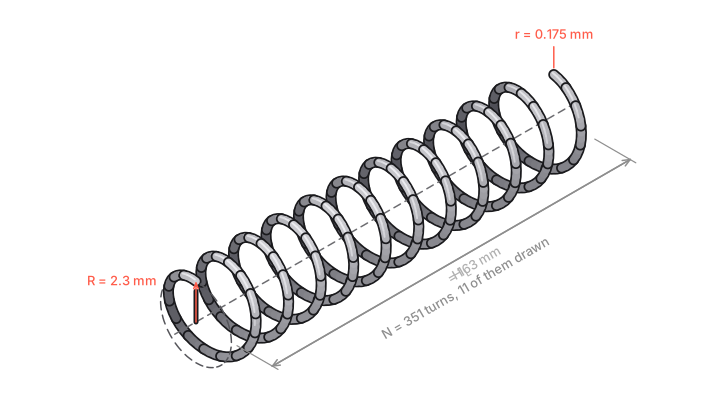
Make a note of these symbols:
- \(E\)
- steel's stiffness (Young's modulus), \(2 \times 10^{11}\) Pa
- \(\rho\)
- steel's density, 7800 kg/m\(^3\)
- \(c\)
- \(E/\rho\), the square of the speed of a wave in bulk steel
- \(R\)
- the radius of the coil, 2.3 mm
- \(r\)
- the radius of the wire, 0.175 mm
- \(N\)
- turns, 351
- \(H_L\)
- how long the spring is in the tank, 163 mm
- \(L\)
- the wire unrolled, 5.075 m
- \(\kappa\)
- \(1/R\), the curvature of the helix, 435 m\(^{-1}\)
- \(s\)
- distance along the wire
- \(u\)
- how far a bit of wire moves along itself (the twist)
- \(v\)
- how far it moves sideways, in the plane of the coil (the bow)
- \(m\)
- the mode number, 1, 2, 3...
- \(k\)
- \(m\pi/L\), the wavenumber
- \(\omega\)
- \(2\pi f\), radians per second
- \(\lambda\)
- \(\omega^2\), the eigenvalue
- \(\sigma\)
- the damping rate, in radians per second
- \(F_C\)
- the transition frequency, where the echoes turn around
- \(T_D\)
- the echo time: one round trip down the spring
Running numbers: \(R = 2.3\) mm, \(r = 0.175\) mm, \(N = 351\), \(L = 5.075\) m.
Inseparable waves
Here's the thing about a curved rod. If it's bent sideways and you stretch it, even a little, the outside of the bend becomes longer than the inside. Twisting it swings it sideways. On a straight rod those two motions are independent; in a helix they absolutely are not. The curvature is the link here, given by \(\kappa = 1/R\).
Fletcher's in-plane helix equations, as Parker and Bilbao write them down for a spring reverb:
Quick refresher on subscripts and derivatives. Think of it like this: one derivative is velocity. Two is acceleration. So we have \(u_{tt}\), which is acceleration along the wire, and \(u_{ss}\), which is how much the wire is stretched. Interpret the first line as: the wire accelerates along itself because it's stretched, plus an accounting of the coil's curvature turning sideways, sloping into length. The second line is a bending equation, which is the same \(v_{ssss}\) shape a beam has, which is driven by the same coupling from the other side.
Any guess on what's missing? If you guessed tension, congratulations! A spring in a tank hangs loose, so there isn't any string tension pulling it straight. The stiffness is all in the steel's own bending and stretching. All the numbers below come from of the wire's thickness and the coil's radius.
Standing waves on a helix
A tank's spring ends at two magnets. So we need to define what happens at the ends before we can define anything about frequencies: each end the wire can't move sideways, and it's free to twist. Pinned sideways, stress-free along itself.
Functions on \(s \in [0, L]\) that do that are just sines and cosines. “\(s \in [0, L]\)” just means \(s\) can be any value from \(0\) to \(L\), including both ends:
We can check both ends pretty quickly. \(u_s = -kU\sin(ks)\) is zero at \(s = 0\) and \(s = L\), since \(\sin(0) = 0\) and \(\sin(m\pi) = 0\). Same goes for \(v = V\sin(ks)\). So both boundary conditions work.
SO much easier to work with. We aren't tracking every point on the spring, because we're describing it as a bunch of standing waves. Each wave fits a whole number of half-wavelengths along the wire. For this particular spring, the clips further down use 372 of them.
Two by two
Now we sub the sines and cosines into the two equations. Every term in them is a derivative of a sine or a cosine, so write them all out first. \(k\) is a constant:
where \(u_{tt} = -\omega^2 u\) because a mode at frequency \(\omega\) oscillates as \(e^{j\omega t}\), and two derivatives pull down \(-\omega^2\).
Into the first equation. Every term comes with a \(\cos(ks)\) attached, so it divides out and what's left is arithmetic:
Second equation. Collect the \(v\) terms in the bracket, since they're all sines:
because factoring \(k^4 - 2k^2\kappa^2 + \kappa^4\) gives us \((k^2-\kappa^2)^2\). The bending term has the shape it does because of this. Sub it back and the \(\sin(ks)\) divides out:
with \(A = \frac{cr^2}{4}(k^2-\kappa^2)^2\) being the bending stiffness.
Let \(\lambda = \omega^2\). \(\lambda\) is just shorthand for \(\omega^2\), the angular frequency squared. This is what we need to solve for to figure out how fast a standing wave naturally vibrates. Once we've got it, \(f = \sqrt{\lambda}/(2\pi)\) gives the frequency in Hz. It's called an eigenvalue here, but don't confuse that with wavelength. \(p\), \(q\) and \(s\) are three numbers in a matrix of four slots, and the immediate problem is that \(s\) appears twice because the two motions are coupled to each other. Solving this means finding which balances of twist and bend can vibrate together, and at what frequencies. This is what's called the eigenvalue problem:
\(p\) is the stretch, \(q\) is the bend, \(s\) links them together. If \(s\) is zeroed, stretching the wire won't make it bend, or the other way round. This would totally defeat the point; we'd lose the interaction that gives the spring its characteristic sound!
The eigenvalues
\(\lambda\) comes from setting the determinant to zero, \(\det(M - \lambda I) = 0\):
Which is a quadratic, so the quadratic formula does the rest:
The \(pq\) terms cancel when the square is expanded:
so the low branch, the audible one, is
The high branch uses the same formula with a plus instead of a minus, because this is the quadratic formula, remember?. Both roots are real because the matrix is real and symmetric. The high version is a fast radial vibration at around 350 kHz, which we can totally disregard because it's way beyond audible range.
The root
When discretized, this formula can lose accuracy. At low frequencies \(p\) is much smaller than \(q\), so we can actually end up subtracting two numbers that are almost the same. We're after a really tiny answer, and rounding can wipe out a lot of it if we're not careful. To get around that, multiply the top and bottom by the same thing, with the minus changed to a plus. That's the conjugate. The fraction we're multiplying by is just 1, with \(D = (p-q)^2 + 4s^2\):
Nice, no cancellation. Represented in code:
struct Spring {
    double c, kappa, r, L;   // E/rho, 1/R, the wire radius, the wire unrolled

    // lambda = omega^2 for mode m: the two branches, low one first
    std::pair<double, double> branch(int m) const {
        const double k  = m * M_PI / L;
        const double p  = c * k * k;                      // stretch
        const double d  = k * k - kappa * kappa;
        const double A  = c * r * r / 4.0 * d * d;        // bend
        const double q  = c * kappa * kappa + A;
        const double s  = c * kappa * k;                  // the coupling
        const double tr  = p + q;
        const double det = p * q - s * s;                 // = c * k * k * A
        // the conjugate form: no cancellation when p is small
        const double low = 2.0 * det / (tr + std::sqrt(std::max(0.0, tr * tr - 4.0 * det)));
        return {low, tr - low};                           // the roots sum to the trace
    }

    // and a frequency, in Hz
    double hz(double lambda) const { return std::sqrt(lambda) / (2.0 * M_PI); }
};
We can infer from the matrix how much the wire bends relative to how much it twists. Take a single row of \(M - \lambda I\), rearrange it, and get \(V/U\):
The low modes mostly twist, with barely any sideways movement. As \(k\) gets bigger, the wire bends more too. At \(k = \kappa\), the twist and bend are pretty much equal. Going beyond this produces more bend than twist.
Branching
You may be wondering, what happened to our determinant? It's still relevant! Multiplying it out disappears the coupling:
The determinant is the stretch multiplied by the bend: the \(c^2k^2\kappa^2\) terms cancel exactly. This can be written in C++ as a single multiply. The low root has one power of the determinant on top; it's why the low root comes out small.
To expand it, look at what's under the root. Sub \(q = c\kappa^2 + A\) in and square it:
and the two \(k^2\kappa^2\) terms combine, because \(-2 + 4 = 2\):
So the argument is a perfect square with a small correction on it. Pull the square out and name the correction:
Down at the bottom of the band \(\varepsilon\) is about \(10^{-3}\), so the root is the first two terms of \(\sqrt{1+u} = 1 + u/2 - \ldots\):
That's the square root that subs into the denominator. Add it to the trace, group the \(A\) terms together:
The bracket collapses! The \(k^2\)s cancel and leave the \(\kappa^2\)s:
Sub it back in the root, with \(2\det = \frac{c^2r^2}{2}k^2\bigl(k^2-\kappa^2\bigr)^2\):
In the last step we left out a small term in the denominator. At low frequencies it's no more than about \(0.145\%\) of the part we're actually keeping. Dropping it makes a negligible difference to the answer.
The dimensionless wavenumber
The characteristic sound is in that line! The frequency starts at zero (\(k = 0\)), rises, then returns to zero at \(k = \kappa\). This is pretty complex already, so to make the maths easier, let \(y = (k/\kappa)^2\). That splits the two zeros between \(y = 0\) and \(y = 1\). Each part becomes:
To find where the curve peaks, we need its slope to be zero. First expand the top of the fraction, then use the quotient rule to find the slope:
The quotient rule is \(f' = \bigl(N'(1+y) - N\bigr)/(1+y)^2\), so multiply \(N'\) out first:
taking \(N\) away from it cancels most of it:
Set that to zero and it factors, one root is all we need. The fraction is zero at \(y = 1\), which is the other end of the branch, so \(y - 1\) divides out:
Checkable by multiplying it back out: \(2y^3 + 3y^2 - y - 2y^2 - 3y + 1\). The quadratic's roots are \(\bigl(-3 \pm \sqrt{9+8}\bigr)/4\), so the one inside the branch is
So the branch peaks at \(y^\star\), which is \(k = 0.53\,\kappa\), about half way to \(k = \kappa\) (it's \(y\) that's a bit over a quarter of the way). The fraction is worth \(f(y^\star) = 0.1134\) there, and the frequency follows from the branch:
Plug in our spring's numbers in and we get about 4489 Hz. Parker and Bilbao use \(F_C = \frac{3r\sqrt{E/\rho}}{16\sqrt{5}\,\pi R^2}\), which is a similar answer. The difference is about \(0.4\%\), so lets call it 4.5 kHz.
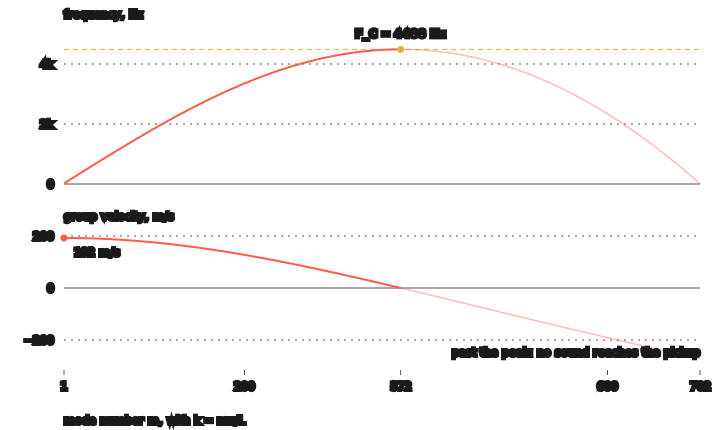
The second panel is a chart showing how fast the wave's energy travels. This is the group velocity; the slope of \(\omega\) against \(k\). Low frequencies travel at more or less the same speed. Near \(F_C\), they slow right down to zero. Past the peak, the slope turns negative: this means the energy travels in the opposite direction to the wave's phase.
A spring reverb has a dark tone no matter how you drive the brightness of the source precisely because \(F_C\) is the top of the low branch, and that's where most of the energy travels. Waves below it travels along the wire. Above it there's only the part of the branch past \(k = \kappa\), which is mostly bend, and the magnets twist the wire, so it barely gets driven.
The other number
The aforementioned curve is actually very useful! We can use the same curve to work out the delay. At low frequencies \(y\) is close to zero, so \(y(1-y)^2/(1+y)\) is roughly just \(y\). Sub that in, then swap \(y\) for \(k^2/\kappa^2\) so we're working with \(k\) again:
Linearity through the origin! This means that down there the spring isn't dispersive at all. Dispersive just means different frequencies travel at different speeds. The slope of the line is the speed, since \(\omega = vk\) means \(d\omega/dk = v\):
If one trip down the wire is \(L/v_g = 26.4\) ms, then a round trip is \(2L/v_g\). We get the necessary geometry from rearrangment:
This second number is our geometry! \(T_D\) is the echo spacing, audible as the spring's pitch. Longer wire, bigger coil or thinner wire all push the echoes further apart.
The signature chirp
Combining these two numbers gets us the sound we're looking for. Low frequencies travel at 193 m/s. Higher ones travel slower than that. The ones closest to \(F_C\) barely travel at all. If you send an impulse through the spring, you will find that the low frequencies arrive first relative to the higher frequencies, and this sounds like a quick sweep from low to high. That audible effect is called a rising chirp.
There's another set of chirps that are generated from a different wave motion in the wire, and arrive later. The maths pretty much work out the same way. The curve rotates at a frequency about 10% lower, with echoes arriving give-or-take 14% later. That extra delay comes from \(\sqrt{1+\nu}\), where \(\nu\) is Poisson's ratio, defined as a measure of how much the steel narrows when stretched. Both are audible in a real tank, though the second set is weaker and more spread out. The whole spring can also swing sideways, you'll hear that if you knock the tank against whatever it's sitting on.
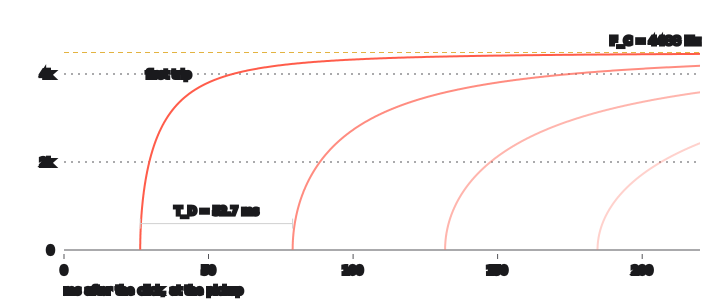
Here's what that sounds like. These are worked out mode by mode with our spring's numbers, one little resonator per mode. The straight wire has the same echo time with the dispersion taken out, so you can hear what the helix adds.
Losing energy
Without friction, this will never stop ringing. We need to add a coefficient, a \(-2\sigma x_t\) term, which is just a damped oscillator:
In code that's a two-pole resonator per mode, with \(T = 1/f_s\). You can hear that in action in the clips above.
Steel loses more energy at higher frequencies. There are felt damper pads that do most of the work in setting how long it rings. T60 is how long the sound takes to drop by 60 dB. If that's \(t\) seconds, we can work out \(\sigma\):
The ends
Real pinned ends in a spring reverb don't reflect everything. The wire's glued into a magnet that hangs on a little suspension. Each end is a mass on a spring with some friction. Around its own resonance it soaks energy up and notches the echoes. The drive and pickup ends are built differently: repeats have variance. It's a big part of the characteristic sound.
The coils
A coil is \(Z = R + j\omega L\). Once \(\omega L\) passes \(R\), the current falls 6 dB per octave:
Less current up top means a darker, muddier spring. You can either boost the drive 6 dB per octave or drive it with a constant current. Regarding the pickup, the coil resonates with whatever capacitance hangs off it, cable included. That bump is around 2 to 4.6 kHz and adds about 3 to 9 dB. It's a big part of the drip sound you hear. The pickup only outputs 3 to 15 mV, so it needs about 40 dB of gain after it. The amplifier itself needs to be kept quiet or you risk raising the noise floor substantially.
Pushing it
This is all kind of insignificant and normal levels, because cranking the gain on a real spring drive changes character:
- The magnet hits its pole pieces. It only pushes when it touches, so it clanks. Harder hits clank differently.
- The core saturates. The iron bends over. Hysteresis is memory! Jiles-Atherton is the usual model.
- The magnet swings out of the gap. The push drops off roughly as \(\cos(x/\text{swing})\).
- The wire stiffens as it bows. Loud chirps come out a touch sharp or flat next to quiet ones.
TL; DR
A spring is 5 metres of wire wound into a helix, and the curve ties the twist to the bend. That turns the wave equations into a 2 by 2 per mode. Its low branch peaks at \(F_C\), about 4.5 kHz, and that's where most of the sound tops out. The slope at the bottom is the wave speed, about 193 m/s, which gives the echo time \(T_D\), about 52.7 ms. Lows travel fastest, and this is why a click manifests audibly as a rising chirp.
References
The physics is not mine. Any mistakes in the telling are.
- Julian Parker and Stefan Bilbao, Spring Reverberation: A Physical Perspective (DAFx-09): the in-plane helix equations, the boundary conditions, and the geometry tables the numbers above come from.
- Vesa Välimäki, Julian Parker and Jonathan Abel, Parametric Spring Reverberation Effect (JAES 58, 2010): \(F_C\) and \(T_D\) as the two perceptual parameters.
- Laurens Hammond, US Patent 2,230,836 (1941): the original.
- Belton and Accu-Bell datasheets, and Rod Elliott's Care and Feeding of Spring Reverb Tanks: the coil impedances, drive currents, decay times and the 6 dB per octave rule.